

When is Surgery Indicated?
Persistent symptoms or recurrence despite appropriate medical therapy
Insufficient response to medical treatment or relevant side effects
Patients who do not wish to remain on long-term medication
Very large hiatal hernias (mechanical impairment, risk of incarceration)
Patients with concerns regarding long-term effects of medical therapy
Desire to correct the underlying mechanical cause of reflux
Surgical treatment represents a reasonable option when conservative and medical measures are not sufficiently effective or when long-term therapy is not desired.
Goals of Surgical Treatment
In contrast to purely medical therapy, surgery aims to restore the anatomical and functional conditions at the gastroesophageal junction.
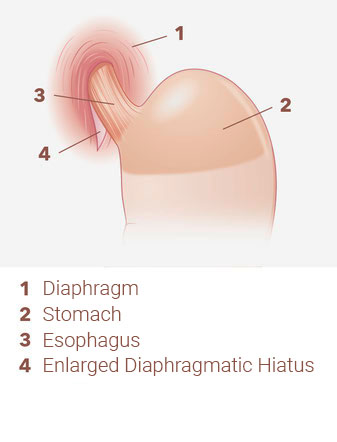
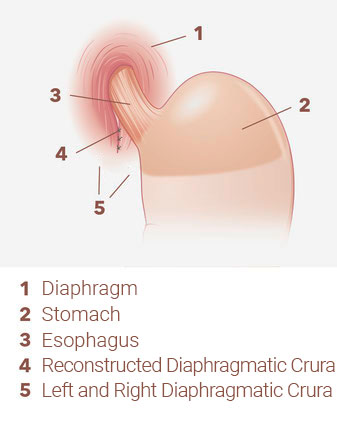
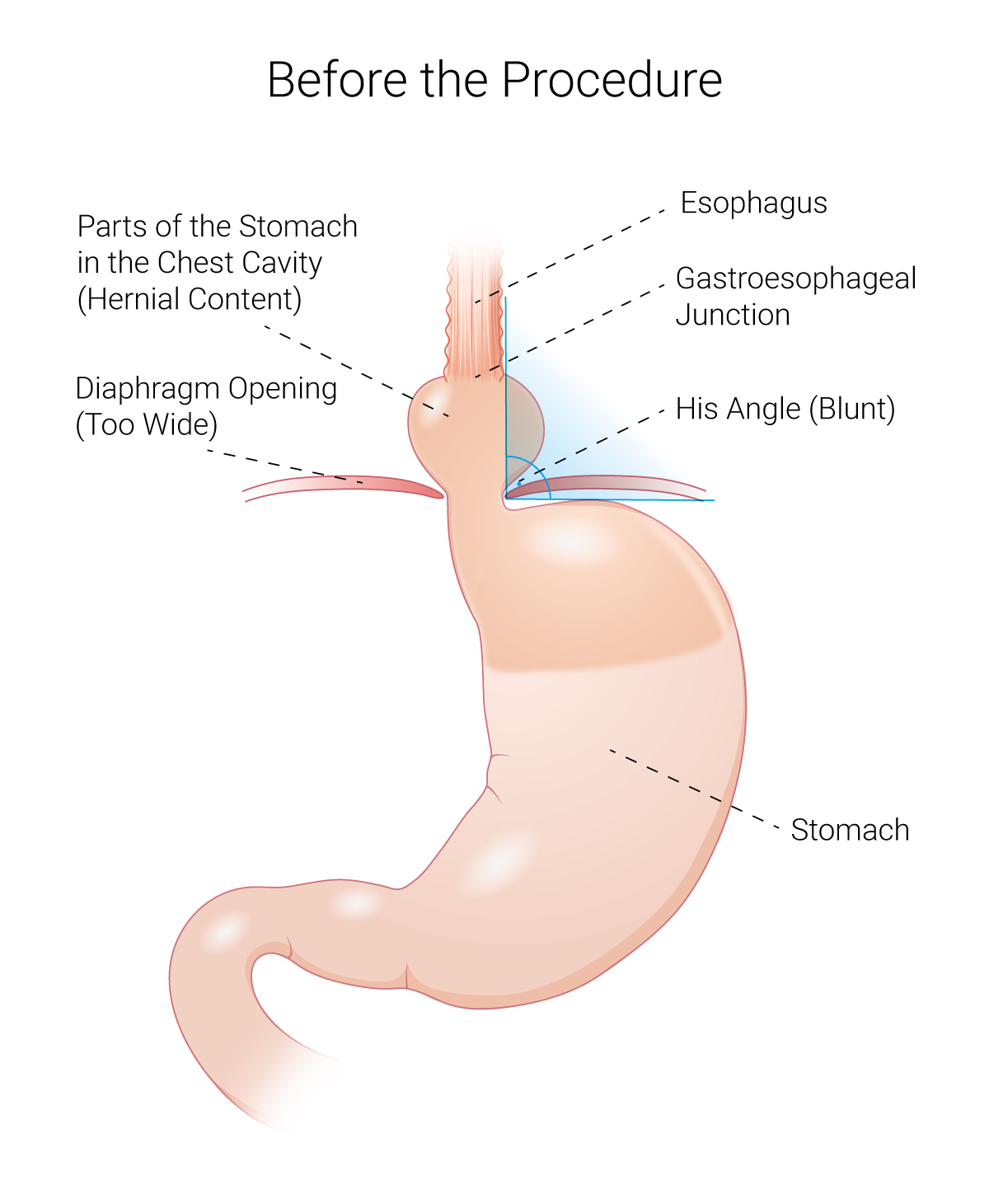
The primary goal of surgical treatment is to reposition the herniated contents (most commonly the upper part of the stomach) from the thoracic cavity back into the abdominal cavity. In addition, the enlarged diaphragmatic hiatus must be reconstructed.
Further operative steps are required to achieve durable reflux control. Various surgical techniques are available for this purpose, each based on different functional principles.
Widened Diaphragmatic Hiatus
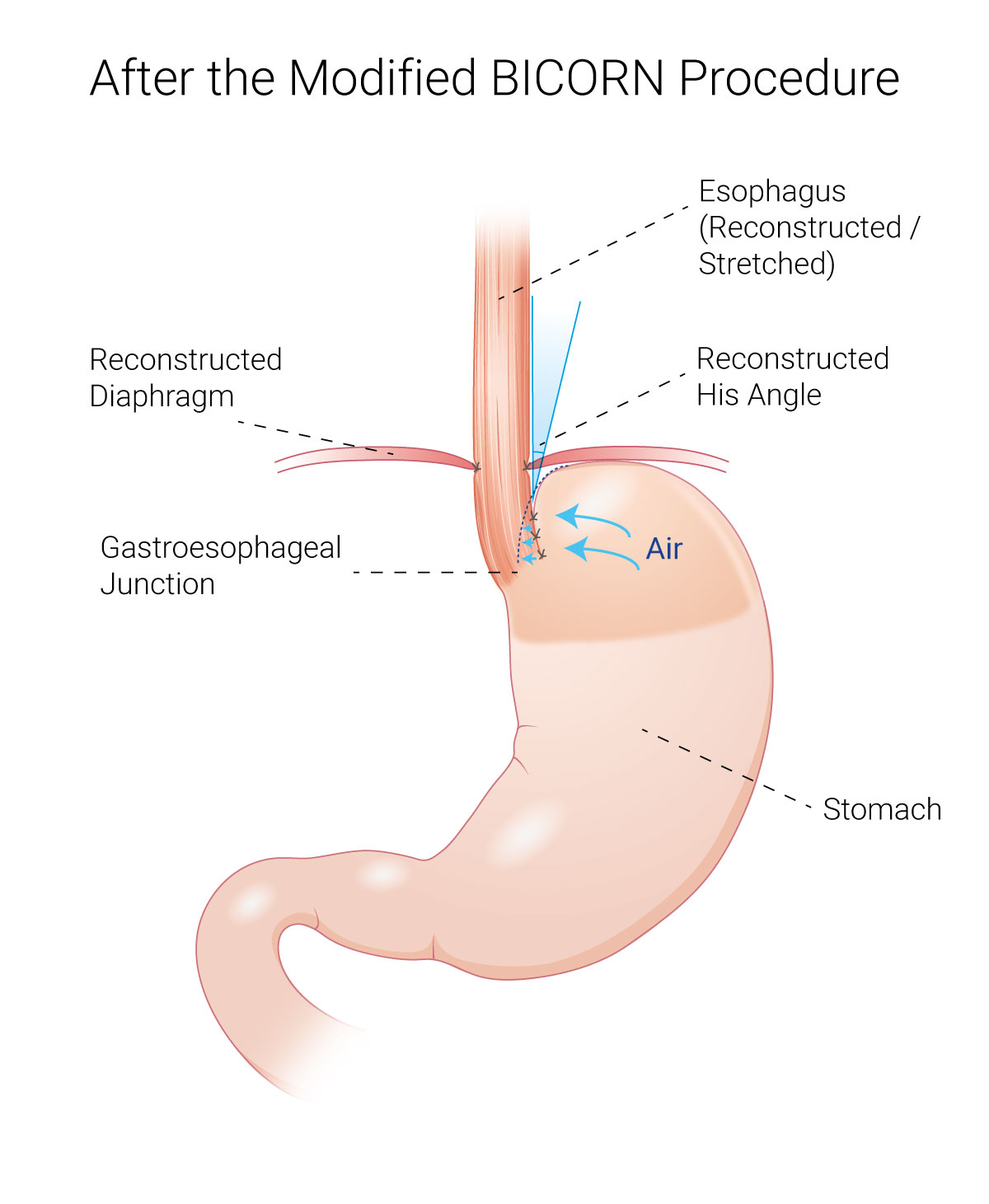
Diaphragmatic Reconstruction (Hiatoplasty)
Surgical Approach
Operations for gastroesophageal reflux disease (GERD) and hiatal hernias can generally be performed either as an open procedure (through an abdominal incision) or using a minimally invasive approach, either conventional laparoscopic surgery or robot-assisted laparoscopic surgery. Both techniques are minimally invasive and are performed through small abdominal incisions.
Today, the vast majority of these procedures are performed using minimally invasive techniques. An open operation is required only in exceptional circumstances, for example if unexpected major complications arise during surgery that no longer allow the procedure to be completed safely using a minimally invasive approach.
Whether a procedure is performed using conventional laparoscopic surgery or robot-assisted laparoscopic surgery depends primarily on the treating surgeon’s preferred surgical approach and is discussed with each patient before surgery.
The success of antireflux surgery depends primarily on meticulous surgical technique and the experience and specialization of the treating surgeon. In most cases, whether the procedure is performed using conventional laparoscopic surgery or robot-assisted laparoscopic surgery is of secondary importance.

Wrap Procedures
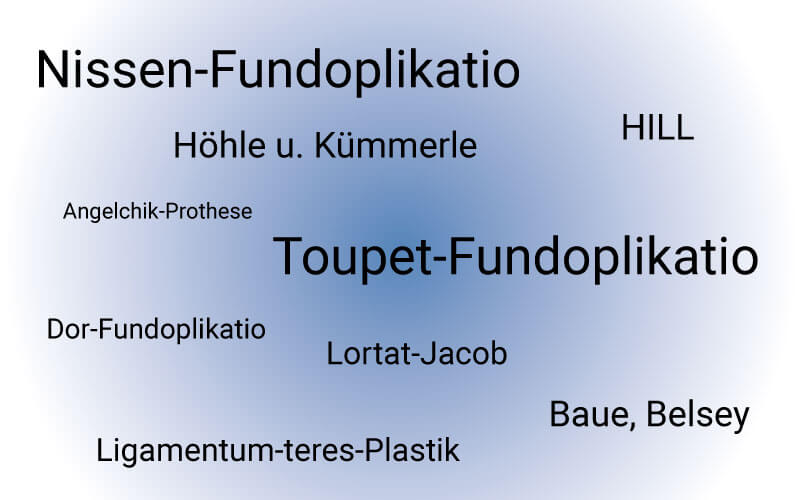
Fundoplication
Fundoplication is one of the surgical methods that has been established for decades.
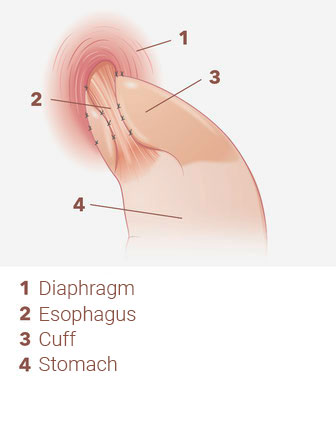
In this procedure, the uppermost part of the stomach is fashioned into a cuff around the lowest section of the esophagus.
Nissen and Toupet Fundoplication
In Nissen fundoplication (first described in 1956), the gastric fundus is wrapped completely (360°) around the esophagus. This wrap is secured to itself and in part additionally fixed to the esophagus.
In Toupet fundoplication (first described in 1963), the gastric fundus is positioned as a posterior partial wrap (270°) around the esophagus and fixed to it.
Reflux control is generally effective and well documented; however, it is associated with functional limitations.
Due to the circumferential fixation, the natural functional dynamics of the gastroesophageal junction are altered. Belching is often impaired, and vomiting may be significantly restricted.
Nissen fundoplication (posterior 360° cuff)
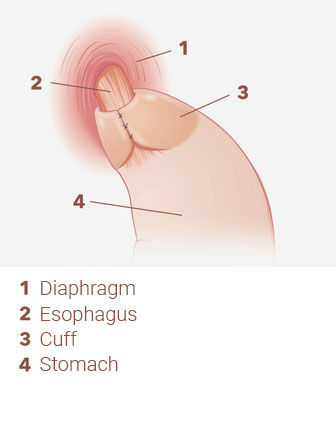
Toupet fundoplication (posterior 270° cuff)
Reconstructive, Function-Preserving Procedures
Reconstructive concepts follow a fundamentally different approach.
The focus is on restoring normal anatomical conditions while preserving the physiological relaxation capacity of the gastroesophageal junction.
The goal of surgery is complete symptom relief and avoidance of long-term medical therapy.
Classical BICORN Procedure
(first described in 2004 by Bernd Ablassmaier)
The classical BICORN procedure is a reconstructive surgical concept.
It includes—where necessary—the tension-free repositioning of a hiatal hernia with restoration of esophageal length and reconstruction of the enlarged hiatus. Subsequently, the angle of His is selectively reduced.
No wrap is created.
Modified BICORN Procedure
(further developed in 2014 by Mischa Feigel)
The modified BICORN procedure represents a further development of this reconstructive concept.
The aim is a stable and long-term reliable reconstruction of the gastroesophageal junction while preserving its physiological function.
Through tension-free functional fixation of the esophagus at the level of the diaphragmatic hiatus, anatomical stability is improved and the risk of recurrence reduced.
Physiological Reconstruction and Functional Stabilization
Under normal conditions, intragastric pressure increases during belching or vomiting, while the gastroesophageal junction simultaneously relaxes. This coordinated relaxation allows controlled release of air or gastric contents.
Wrap-based procedures create a circumferentially fixed pressure barrier. The physiological relaxation capacity is largely lost. As intragastric pressure increases, pressure within the wrap also rises. As a result, belching is often impaired, and vomiting is usually significantly restricted.
For repositioning of a hiatal hernia, the anatomical attachments between the esophagus and diaphragm must be released within the operative field. This is followed by precise reconstruction of the diaphragmatic hiatus.
In the modified BICORN procedure, no gastric wrap is created. The goal is to restore anatomical and functional conditions while preserving physiological function.
The angle of His is selectively reconstructed with slight accentuation. The fundus lies adjacent to the distal esophagus. As gas rises within the stomach, the junction is gently compressed from the left, resulting in functional narrowing. This does not create a rigid wrap, but rather a dynamically functioning pressure zone.
The goal is long-term control of reflux while preserving the natural ability to belch and vomit. This functional integrity is a key factor for postoperative quality of life.
Mesh Reinforcement in Selected Cases
In most patients, the hiatal opening can be reconstructed securely using sutures alone. Only in a small minority of cases, such as very large hiatal hernias, recurrent defects, poor tissue quality, or when excessive tension remains on the repair despite careful reconstruction, additional mesh reinforcement may be considered.
Different mesh materials are available, including absorbable, partially absorbable, and permanent meshes. Each option has specific advantages and potential drawbacks that must be considered on an individual basis.
The possible use of a mesh is generally discussed with patients before surgery. Occasionally, however, the final decision can only be made during the procedure, once the anatomy, tissue quality, and tension on the repair have been fully assessed.

Implant-Based Systems (Not Used in Our Center)
In recent years, various implantable systems have been developed to mechanically support the gastroesophageal junction, including magnetic ring devices and other permanent implants.
These approaches differ conceptually from anatomical reconstructive surgery. The use of foreign material introduces specific considerations and requires careful individual evaluation.
Implant-based procedures are not part of our treatment concept.
What You Can Expect From Surgery
The goal of the modified BICORN procedure is to eliminate reflux symptoms, allow healing of reflux esophagitis, and enable long-term symptom-free living.
Typical symptoms such as heartburn, acid sensation, regurgitation, volume reflux, retrosternal burning, or nocturnal cough usually improve significantly or resolve completely.
By restoring normal anatomy at the gastroesophageal junction, the mechanical cause of reflux is addressed.
Symptoms of so-called silent reflux—such as hoarseness, throat clearing, foreign body sensation, or throat irritation—also improve in most cases, although often more gradually than classic symptoms.
In most cases, long-term use of PPIs is no longer required after surgery.
In patients with Barrett’s esophagus, regular endoscopic surveillance remains necessary depending on its extent, regardless of symptom control.

Risks and Potential Complications
The vast majority of procedures are performed without complications. Nevertheless, potential risks are discussed transparently, as clear information is the basis for an informed decision.
Each procedure is preceded by personal counseling and explicit informed consent; written documentation is standard medical and legal practice.
General risks include bleeding, infection, thrombosis, or pulmonary embolism. These are rare; appropriate prophylactic measures are routinely implemented during hospitalization.
Specific risks include injury to the esophagus or stomach and, rarely, adjacent structures such as the spleen, liver, diaphragm, lung, or major vessels.
In rare cases, the vagus nerve may be affected. This can lead to delayed gastric emptying or narrowing at the gastric outlet, which may present as early satiety or fullness. If necessary, this can be treated endoscopically or with an additional minimally invasive procedure. Residual symptoms cannot be completely excluded in every case.
Recurrence of reflux or hiatal hernia is rare but possible. The underlying cause is connective tissue weakness, which cannot be corrected surgically. Careful surgical technique reduces this risk but cannot eliminate it completely.

Surgical Experience and Specialized Center Team
As a visceral surgeon, I have been involved in the treatment of reflux disease for over 30 years. Through this specialisation, I have performed well over 1,000 antireflux operations.
For many years, laparoscopic Toupet fundoplication was my standard procedure. Reflux control was reliable; however, as is known with wrap-based procedures, functional side effects such as impaired belching, bloating (gas-bloat syndrome), or inability to vomit were common.
Based on these experiences, I specifically further developed and decisively refined the reconstructive approach of the classic BICORN procedure—into the modified BICORN procedure I use today. Since 2014, this technique has been the focus of my surgical work in reflux surgery.
I have now performed many hundreds of these reconstructive procedures—with consistently good clinical outcomes and high patient satisfaction. Thanks to the function-preserving approach, the physiological ability to belch air and to vomit is generally maintained, which contributes significantly to quality of life.
Part of my work also includes recurrence and revision surgery. Such procedures place special demands on surgical experience and anatomical understanding and should be reserved for specialised surgeons with proven expertise in reflux surgery.
The procedures are performed with my specialised reflux surgery center team, consisting of experienced specialists with whom I have worked closely for many years. This continuity of personnel ensures well-coordinated processes and a structured four-eye principle as an additional safety measure.

Frequently Asked Questions
Do I need to continue taking reflux medication after surgery?
Following successful surgical restoration of the anatomical conditions, long-term use of acid-suppressing medication is generally no longer required.
Will I still be able to belch or vomit after surgery?
A key objective of the surgical technique is to preserve the natural function of the gastroesophageal junction. In the vast majority of cases, both the ability to belch and the ability to vomit are preserved.
Is the procedure durable, or can reflux recur?
In most cases, surgical treatment results in sustained symptom relief. Recurrence of reflux symptoms is possible in principle but overall very rare.
What are the risks associated with the procedure?
As with any surgical intervention, general risks such as bleeding, infection, or injury to adjacent structures exist. The procedure itself is well established and associated with an overall very low complication rate.
Who is a suitable candidate for surgical treatment of reflux disease?
Surgical treatment may be particularly appropriate for patients in whom conservative and medical therapies are insufficiently effective, not well tolerated, or when there is a desire to avoid long-term medication.
Patients with mechanically induced reflux of gastric contents or acid extending into the upper chest, throat, or mouth—particularly when lying down—tend to benefit most. In these cases, surgical restoration of the anatomical and physiological conditions may result in complete symptom resolution.
How is the procedure performed, and how long is the recovery in the hospital?
The procedure is performed using a minimally invasive approach. The hospital stay typically lasts two nights. Recovery continues gradually over several weeks, during which physical exertion should be temporarily limited.
What diagnostic evaluation is required prior to surgery?
A thorough preoperative evaluation is essential. This includes a detailed medical history and physical examination.
Upper endoscopy (gastroscopy) and assessment of esophageal motility using high-resolution esophageal manometry are mandatory.
Depending on the findings, additional testing may include measurement of acid exposure, either by 24-hour impedance-pH monitoring or by a 48-hour pH study using a BRAVO capsule.
In selected cases, contrast radiography of the esophagus and the gastroesophageal junction may be performed. Further diagnostic tests are guided by the individual clinical situation.